Marketing: So You’ve Written a Novel

Unknown

Marketing: the action or business of promoting and selling products or services, including market research and advertising.

How does one use marketing to sell books? Theories and tools abound but none can legitimately lay claim to a surefire technique. The rapid ascension of self-publishing has thrown a kink into time tested models and everyone in the publishing industry is scrambling to adapt.

When listening to speakers at a writing/editing/publishing conference I attended there seemed to be a unanimous approach to modern marketing from independent, small, medium, and large publishers—the shotgun method. Splatter the wall and see what hits. Not the most efficient or eloquent of approaches but no one seems to be able to say for certain what will, and won’t, work.

The phrase, “Write the best story possible and the cream will rise to the top,” kept appearing at the conference as well. How then to explain massive successes like 50 Shades of Grey? Clever marketing obviously had a hand in making that poor-to-mediocre story a success. I think it all comes down to word of mouth. The more people talking about a product, or at least are aware of it, then the higher chances of potential sales.

The shotgun method is an attempt to connect with various streams in the hopes that one, or multiple, will raise awareness of the book and author. Sounds easy enough but when everyone is doing it then the “cream” has a lot more crap to rise through to get to the top.

The amount of available funds at a publishers disposal also plays a major role in marketing. Rarely can a self-published author match the concerted and widespread marketing effort of a Big 5 publisher. Not all shotgun blasts are created equal. Not everyone gets to reload.

But what about social media? It’s free and ubiquitous! There are many success stories of self-published authors using social media to raise awareness and even the big time authors with big time contracts have to be involved on social media. Yet I can’t help but get philosophical about the apparent advantages of social media—if a self-published author blogs does anyone hear it? Do all tweets come from songbirds or is it just a bunch of honking geese?

Whatever the case, I’m trying my own shotgun method with my novel, Daughter of Shadow. I have to admit that aspects of marketing are fun—it’s like jumping into a game that’s already in process and nobody fully understands the rules. The most frustrating part is the not knowing. What works? What doesn’t? Why?

It’s incredibly easy easy to drop a piece of yourself into the internet but most of the time that piece sinks away never to be seen or heard from again. Maybe message in a bottle method is more appropriate than shotgun, although the reference to a weapon conveys a sense of control and applied direction rather than casting out wishes and hoping for the best.

To close on a point of optimism—we’re all in this together. The big time authors and first time self-pubs are all caught up in the same game. I can read Rothfuss, King, Gladwell, and Le Guin all at the same time and everyone wins, because the beauty of writing is that it’s meant to be shared. Books are a very different product then say a blender; you can never have too many.

Tough Women

The damsel in distress days are over. Women are more than capable of solving (and creating) their own problems. A female character no longer has to wait for rescue from prince charming, she can save herself and kick the bad guy’s ass in the process.

Gender equality, while not perfect, seems to have reached a level of acceptance where strong and flawed feminine characters are being recognized in popular culture. People want to view and read about these characters because they are relatable. Aspects of these heroines exist in reality, their attributes plucked from the personal and collective milieu. The bones of fantasy and sci-fi elements mirror those from our day to day lives and many of our lives are filled with complex, independent women.

When I began writing Daughter of Shadow there was no doubt in my mind that the story revolved around a strong female character.  Her name is Melea and she bucks the classic tropes of a fantasy protagonist. I don’t want to give too much away but when the story begins she’s certainly not a hero and would kill anyone who labeled her as villain.

A recent reader review of Daughter of Shadow described Melea as a “tragic, Don Draper character.” This comparison blew my mind—the manliest guy on a show where the word men is even in the title (Mad Men) was legitimately compared to a young female character in a fantasy novel. There are similarities: an outwardly successful individual with a carefully managed persona who is constantly being disrupted by a haunted past. In Mad Men, Draper drinks and humps his way through the 1960’s as his way of coping with this internal conflict, a cliche usually reserved for men. This is not always the case as the motif is flipped in the new Netflix series, Jessica Jones.

Jones is a foul mouthed, hard drinking, fiercely independent woman working as a private investigator. A childhood accident made her the recipient of superpowers and she’s caught in the struggle of what to do with this unwanted power. The first season is fantastic and Jones is one of the most interesting new characters I’ve come across.

Then there’s Star Wars: The Force Awakens, the most hyped movie of all time. The saga finds Rey, an intelligent, persistent, caring, resilient woman whose role in the Star Wars universe increases exponentially from her humble beginnings (No spoilers I promise). It’s no accident that Star Wars & Disney teamed up to place a strong female character at the forefront of the biggest movie series in history (Harry Potter and James Bond are in the conversation).

In Paolo Bacigalupi’s, The WIndup Girl, the near future is given a harsh, realistic, breathtaking portrayal and Emiko, a New Person, is the ultimate survivor in a world of hustlers. Emiko is not human, not in the eyes of those around her, so she must overcome the kinds of abuse usually reserved for females as well as what it means to be human. Bacigalupi crafts the story expertly and Emiko’s transformation is a powerful statement about some of the obstacles faced by women in a rapidly changing world.

The Worldbreaker Saga by Kameron Hurley has entire continents of strong women—some nice, some not so nice. The first installment, The Mirror Empire, struck me as a truly modern fantasy novel. The way she bent and broke all the cliches of classic fantasy with seeming ease to create matriarchal societies is a thing of beauty.

I’ve watched an interview with George R. R. Martin where he is asked about his “complex and well-rounded female characters.” Martin chuckles and smirks, looking like he’s about to give a retort that Tyrion would use but then calmly conveys his bewilderment at having to constantly express that women are people. Why shouldn’t they be complex and well-rounded?

Women are tough.  It’s not that woman are changing to fit the definition but the other way around.

Ikigai

AfguRdR

This little beauty is called an Ikigai, a Japanese concept meaning “a reason for being (Wikipedia).” Japanese culture has produced some of my favorite things (sushi, anime, ninjas, samurai, robots) and now the Ikigai is added to the list. The diagram is intended to serve as a reminder of the “reason to get up in the morning” and I think the simplicity and intricacy is fantastic. When you think about it, what else is there? Finding Ikigai is a lifelong search as one develops and matures through various experiences.

In most stories the main character searches for their Ikigai and the writer leads them to it. The search, the path, the conflict, resolution, and growth are laid out by the (mostly) all-knowing author. Perhaps our lives are the same, perhaps not—one has to delve into the topics of faith, destiny, God, and nobody is exiting that existential gauntlet with a clear answer. Storytellers get to create Ikigai and in doing so may stumble into their own.

I know I’ve never felt more in the center of said diagram than when writing. Not all the time to be sure, but enough to instantly jump to that conclusion when I first saw the depiction. When I’m not writing, occupied by time consuming activities like my job or the technicalities of adult life, I do feel out of place—shifted out of the center. When these activities monopolize my time I tend to get the sense of, “ughh what’s the point?” even though they’re pivotal to keeping me fed, clothed, and sheltered. The grunt work of existing isn’t always the most fulfilling.

This sentiment is not to downplay the severity faced by millions of people for whom existing is a daily struggle. I know I have a good life filled with great people and a seemingly infinite set of options. Refugees fleeing war zones might not have the personal security to ruminate on Ikigai. Homeless individuals pushed to the periphery of society certainly have less options for daily living. So to be in a situation such as I am is truly fortunate and to be aware of my Ikigai is something I don’t want to take for granted.

After making the decision to write a novel I became aware of how much meaning writing brought into my life and now there’s no going back. My writing might never achieve huge financial success (would be sweet if it did though) but I don’t think that’s the point. I’ll continue to write, to share stories and create. What is your Ikigai?

Daughter of Shadow Launch Party

IMG_4674

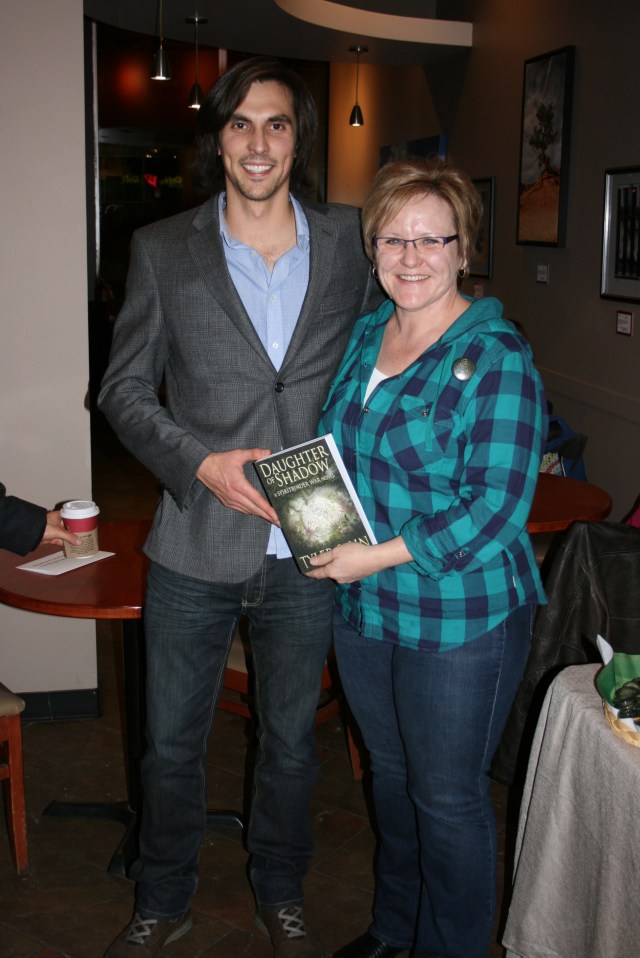
The book launch party for Daughter of Shadow was this past weekend and the support was amazing. The ebook has been available for a few weeks now but it was distinctly more satisfying (as a writer) to hold the book in my own hands. After countless hours staring into a computer screen while writing, dozens of edits, and a few bouts with formatting I finally had a finished product. A very surreal moment.

IMG_4690

The cover art turned out great; I’ve been quite impressed with Createspace. The entire order for the party sold out, which is a good problem to have. Signing copies was fun, a novelty that I doubt will get old anytime soon.

IMG_4683

I created a story but a story isn’t much without someone to share it with. Many thanks to everyone who attended the event and to all those who were unable to attend but still made the effort to contact me.

IMG_4691

The Trap of “Good Enough”

self-publishing_o_900037

All of us dreamers with a wifi connection, an idea, and enough time to type out a few words can be now authors. This predicament is personally inspiring and collectively terrifying. A person can make their voice heard, get their story out into the public, but how many of those voices are incoherent babbling?

There is an invisible rope snare laying in wait for the would-be self-published author, many wander into it unawares and then dangle until giving up. One musters up the courage to write the story and publish it only to have it flounder. But why? Why do the vast majority of self-published authors never earn a cent from their writing?

An obvious answer is that the market is flooded by wannabes telling semi-realized stories riddled with grammatical errors and inefficient (or non-existent) marketing. But every author was a wannabe at some point, those who have “made it” did not wake up one morning with a fresh bestseller under their pillow (Nicholas Sparks might be an exception).

To be a professional in anything isn’t easy; dogged persistence is ineffectual if the skills are lacking and talent can seep away if effort isn’t applied. Professional writers work hard on their stories, endeavoring to create something that rings true, a clear note within the cacophony. My trek towards professionalism is still in progress but I can offer some personal insight from my experience of writing a novel with regards to the trap of “good enough.”

  1. Inexperience—It’s difficult to write an amazing story when one hasn’t spent much time writing. So write! Jot down ideas. Take notes. Try out short stories, poems, essays, novels, blogs, diary entries, etc until the act of not writing feels unnatural. A professional athlete makes it to the big leagues by spending hours upon hours honing their skills so why would becoming a professional writer be any different? Read from different genres and different styles, look for what makes different authors unique. All of this effort aids in creating your own style—no one will believe the words you put down if you don’t believe in them first.
  2. Discipline—Habits. We all fall into patterns that are eventually perceived as the way things are, blinding us to the fact that they are changeable. You, I, the next person you see, are all mostly water—we flow along the path of least resistance at every opportunity. Unfortunately, most times the easy route does not end in a book deal. Habits are stubborn little critters and often need to be actively altered. When you’re absently clicking through the internet and feel the jolt of an idea or the pang of “I should be writing” then start scribbling/clicking away. When you feel like there’s no time to write then make time. Nobody can lie to you better than you can, but luckily you know your own tricks (or can learn them).
  3. Fear of Rejection—Writing is personal and it can be scary to share with others, but sharing is a crucial threshold that needs to be crossed. Find a supportive network that is open to discussing ideas and if you trust the opinion of individuals within this network then share your writing with them. As a writer you need to discover what aspects of your story/style is working and what can be improved. This detail is key: you are not your art. Learn how to accept criticism. The critique is of your art, a creation separate from you as a person, something that can be altered and shaped in any number of ways.
  4. Overexcitement—The desire to “get it out there.” Rushing the process in pursuit of the dream, which results in a story not being ready to hang with the heavyweights. Don’t skip steps because publishing is only a few clicks away. Do your homework, make a plan, put in the extra behind the scenes effort
  5. Hire a Professional—Sometimes an opinion other than that of your unfalteringly supportive best friend is required. Hire a professional when you’re ready to make the jump from amateur to professional (you might not succeed but the odds are tilted more in your favor). Editors are book magicians, it is literally their job to make your story as good as possible. People do judge books by the cover so get an artist. Be thorough, check around, ask plenty of questions before choosing which professional to go with.
  6. Relax—Writing is fun! You love to write. You’re in charge. This project is yours, do what you want with it. When you’re ready, let it go. Art isn’t meant to be perfect or timeless, trying to attain subjective ideals like this can drive a person insane. Be awesome (way more fun than perfect).
  7. Ask Yourself Tough Questions—Everything I’ve described is meaningless without this step. The most important part of DIY is the yourself. Why are you writing? What are you writing? What are you goals? What is your view of success? Is your story realistically comparable to similar titles in the genre? How can it be made better? How do you respond to criticism? Be objective about your story whenever possible (remember, it’s not you, it’s of you). If you’re going to DIY then you better make sure that the project turns out the way you want. I’ve found that satisfaction in this regard is directly associated with excuses. Less excuses=more satisfaction.

There are entire books written on this topic and various self-described gurus out there who claim to be able to guide an author to success. This blog is by no means a replacement for those resources. I understand there is no clear path to becoming a professional writer but I think the seven above mentioned items have validity. My list is not exhaustive or overly detailed (attention spans: yours and mine). I can go into more detail if anyone is interested and would love to hear any tips other writers have to share.